Looking for a Montessori School in South Africa?
Montessori is one of the most-searched terms on our platform right now, and for good reason: more South African parents are hearing about it, more schools are putting it on their sign, and almost nobody is explaining what actually separates a real Montessori classroom from a nice-sounding label. This is that explanation, plus a checklist you can genuinely use on a school visit.
What is Montessori, really?
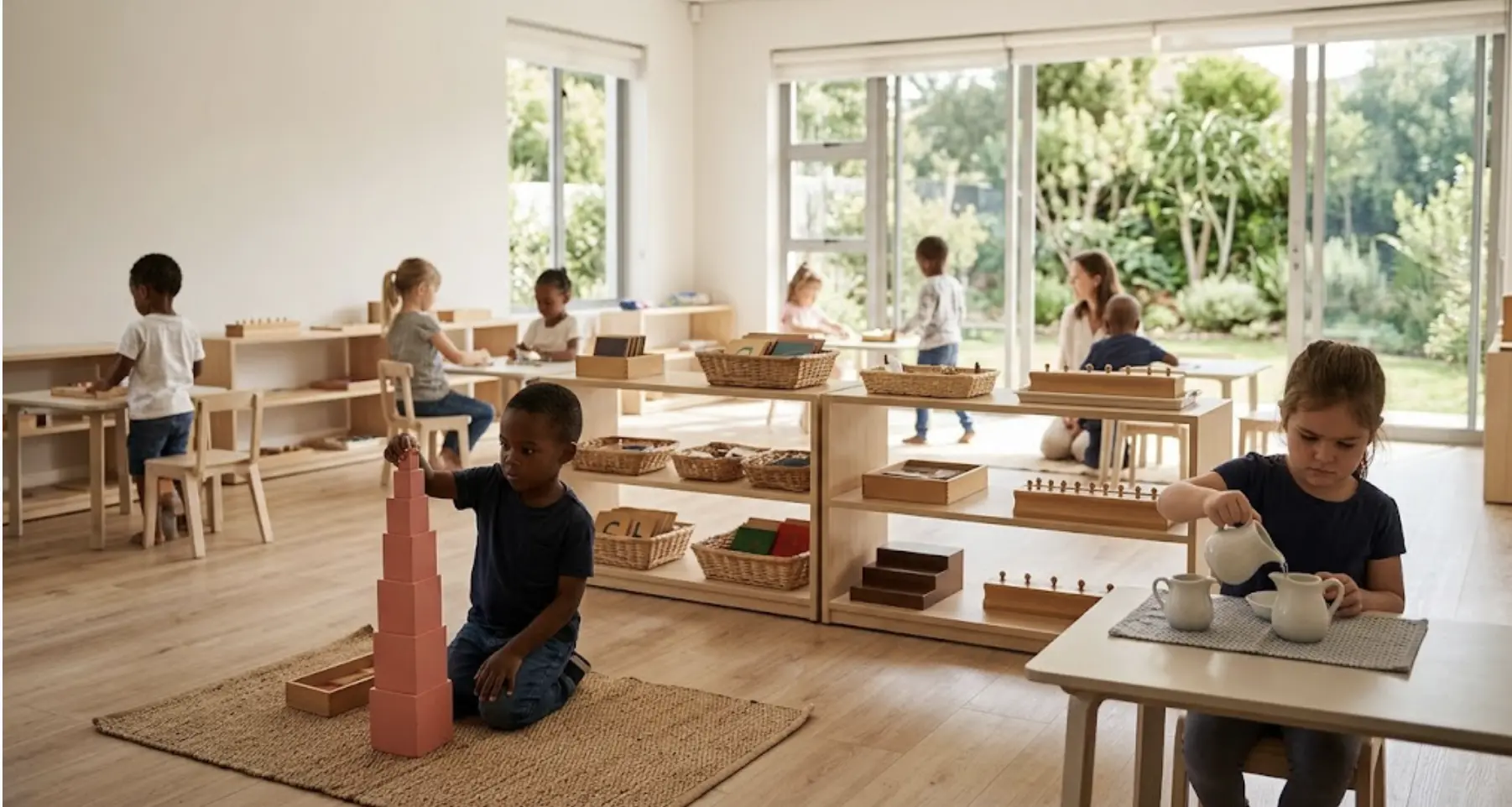
Montessori is a child-led approach developed by Dr Maria Montessori over a century ago, built around a "prepared environment": a classroom of specific, hands-on materials a child chooses and works through at their own pace, under a teacher (often called a directress or guide) who observes and supports rather than instructs from the front. Children of different ages learn side by side in the same room, and work periods run long and uninterrupted rather than in short, timetabled bursts. It's less about a curriculum and more about a whole different relationship between child, teacher and environment.
Is "Montessori" a protected name?
No, and this is the single most important thing to know before you start visiting schools. There isn't a dedicated South African government registration category or licence specifically for using the word "Montessori." That means the word on the sign, by itself, doesn't tell you whether the programme actually follows an established Montessori model, or whether a single staff member has ever done Montessori training, or a single material in the room is genuine Montessori equipment. It's not illegal to use the name loosely. It's just not proof of anything. The checklist below is how you tell the difference yourself, rather than taking the name at face value.
Is Montessori right for your child?

There's no single "Montessori type" of child; the method is designed to work across a wide range of personalities and temperaments. That said, children who are naturally curious, comfortable making their own choices, and engaged by hands-on, real-world tasks tend to settle in quickly. Children who are used to constant adult direction, or who find it hard to stay with an activity without prompting, can take longer to adjust, though most do adapt as they build confidence in the environment. What tends to matter more than the child's personality is whether your family's own values line up with Montessori's, particularly around independence and a slower, less competitive pace, since that's what determines whether the fit feels right at home as well as at school.
How to tell an authentic Montessori programme
Five things separate the real thing from the label. Ask about all five before you enrol, not just the ones on the school's own marketing.
1. Montessori affiliation and accreditation. These are two different things, and it's worth being precise. Affiliation with the South African Montessori Association (SAMA) means a school is connected to SAMA's network, it's a meaningful signal, but it isn't formal accreditation. Genuine accreditation runs through Association Montessori Internationale (AMI), and AMI-affiliated training in South Africa currently runs through a single recognised body, the Indaba Institute, so AMI accreditation specifically is genuinely rare here. Neither is a legal requirement to operate, so ask a school directly which one, if either, applies, rather than assuming SAMA affiliation and AMI accreditation mean the same thing.
2. Staff qualifications. A South African ECD teacher only needs a minimum NQF Level 4 qualification to legally work in a registered centre, and that qualification says nothing about Montessori training specifically. Ask whether the lead teacher in your child's room holds a separate Montessori diploma from an accredited training centre, not just a general ECD qualification.
3. Real materials. An authentic classroom is built around five structured areas: Practical Life, Sensorial, Mathematics, Language, and Cultural, each with specific, graded, self-correcting materials designed to be worked through in sequence. A shelf of generic wooden educational toys with a "Montessori-inspired" label is not the same thing. Ask to see the classroom, not just photos.
4. Mixed-age classrooms. Genuine Montessori rooms group children across a 2-3 year age span (commonly 3-6 together), not split by single school year. Mixed ages are core to how the method works, younger children learn by watching older ones, older children reinforce their own learning by helping.
5. Uninterrupted work periods. Look for long, unbroken blocks of work time, often close to three hours, rather than a school day chopped into 20-minute rotations. Interruption is one of the things Montessori classrooms are specifically designed to avoid.
What to look for when you visit
Book a visit during school hours, not an open day, so you see a real morning rather than a staged one, and walk through this list while you're there:
- Is the room calm and orderly, with materials on open, low shelves a child can reach themselves?
- Are children moving independently between activities, or waiting to be told what to do next?
- Do you see the five material areas (Practical Life, Sensorial, Maths, Language, Cultural) as distinct, well-stocked sections?
- Is the age range mixed within the room, not a single birth year?
- Does the teacher observe and step in only when needed, rather than leading the whole group through one activity at a time?
- Is there outdoor or practical-life work happening as part of the morning, not confined to a single "break" slot?
- Can staff answer, specifically, where their Montessori training came from?
A note on access in South Africa
This part doesn't get said enough in Montessori marketing, so we're saying it plainly. Academic research on inclusive early education in Southern Africa, published in the South African Journal of Childhood Education, found that Montessori education in South Africa is delivered almost entirely through privately owned schools concentrated in affluent urban areas, and remains largely out of reach for lower-income and rural families despite the method's child-centred design being well suited to exactly those children. If cost is a factor for your family, that's not a reason to feel like Montessori is "not for you," it's a real, documented gap in how the method has been rolled out here, not a reflection of whether your child would benefit from it. It's worth knowing going in, and worth asking any school directly about sibling discounts, subsidy eligibility, or payment plans, since fee structures vary far more between Montessori schools than the marketing suggests.
Montessori vs play-based vs traditional: how they compare
| Montessori | Play-based | Traditional | |
|---|---|---|---|
| Who leads the activity | Child chooses, within a structured environment | Child chooses, mostly unstructured | Teacher, whole class together |
| Age grouping | Mixed ages, same room | Usually single age group | Usually single age group |
| Materials | Specific, graded, self-correcting | Open-ended toys and play equipment | Worksheets, group activities |
| Pace | Individual, self-paced | Individual, unstructured | Group pace, set by teacher |
| Typical emphasis | Independence, self-direction | Exploration, open-ended play | Teacher-led structure |
No option here is objectively "better," they suit different children and different family priorities. The comparison is only useful once you know which one you're actually looking at, which is exactly what the checklist above is for.
Questions to ask a Montessori school before enrolling
You've already got the answers you need from the sections above, this is the same information as a checklist to actually take into a meeting with a school:
- What Montessori training does my child's lead teacher have?
- Is the school affiliated with SAMA, or accredited through AMI?
- What age groups are grouped together in my child's classroom?
- How long is the uninterrupted work cycle in a typical morning?
- What Montessori materials do you use, and can I see them?
- Can parents observe a normal classroom session, not just a showcase day?
- What happens if my child struggles to adjust to the Montessori approach?
- What are the fees, and what's included versus billed separately?
- What happens when children transition out to primary school?
Finding a Montessori school near you
We have more than 140 Montessori-tagged nursery schools listed on Find My Nursery. Browse Montessori schools near you and compare their profiles, details and parent reviews →
If you're an ECD owner rather than a parent reading this, we've written a separate guide on how to open a Montessori school in South Africa, covering registration, staff training, materials and real costs.
Quick summary
- "Montessori" isn't a protected name in South Africa. Any centre can use it, whether or not it's genuinely Montessori, so the checklist below matters more than the sign.
- There's no single "Montessori type" of child. Fit depends more on whether your family's values (independence, a slower pace) line up with the method than on your child's personality.
- Check five things before enrolling: SAMA affiliation and AMI accreditation (two different things), staff-specific Montessori training (separate from the general NQF4 ECD qualification), real graded materials across five areas, mixed-age classrooms, and long uninterrupted work periods.
- SAMA affiliation is a meaningful signal but not formal accreditation. Genuine AMI accreditation is rare here, current AMI-affiliated training runs through a single recognised body, the Indaba Institute.
- Academic research shows Montessori in South Africa is delivered almost entirely by private schools in affluent urban areas, a real access gap worth knowing about, not a reflection of whether your child would benefit.
- Montessori, play-based and traditional approaches all suit different children, none is objectively better, know which one you're actually looking at.
Frequently asked questions
Is Montessori better than a regular preschool?
Not objectively, they suit different children and families. Montessori tends to work best for independent, self-directed learners whose families are comfortable with a slower, less competitive academic pace; a play-based or traditional setting may suit others better.
Can any preschool call itself Montessori?
There's no dedicated government registration category or licence for the name in South Africa, so a school can use it without formal Montessori accreditation. That's exactly why the checklist in this guide matters, affiliation, accreditation and materials tell you more than the sign does.
Is Montessori more expensive than a regular nursery school?
Often, yes, though it varies significantly between schools. Research shows Montessori provision in South Africa skews toward privately owned, urban schools, so it's worth asking directly about fees, sibling discounts and payment plans rather than assuming.
What age does Montessori start?
Most South African Montessori environments start with an infant/toddler programme from around 18 months, moving into the well-known 3-6 classroom, with some schools continuing into primary-level (6-12) programmes.
Do I need to commit my child to Montessori all the way through school?
No. Many families use Montessori for the early years and move to a mainstream primary school afterwards; others continue if a Montessori primary programme is available near them.
How do I know if a school's Montessori materials are real?
Ask to see the classroom in person, look for the five distinct material areas (Practical Life, Sensorial, Mathematics, Language, Cultural), and ask where the materials were sourced from, reputable suppliers are typically SAMA associate members.
Ready to find a Montessori school?
Browse Montessori nursery schools near you and compare their profiles, details and parent reviews.
Browse Montessori Schools →Sources: South African Montessori Association · Association Montessori Internationale — South Africa · de Souza, "Inclusivity in early childhood education in Southern Africa: A Montessorian critique," South African Journal of Childhood Education · Montessori Foundation — Is Montessori Right for My Child?

Author: FIND MY NURSERY
The founders of Find My Nursery. Under the Umbrella of FM DIGITAL SOLLUTIONS
Continue Reading
Explore the next article, return to the topic page, or head back to the Parent Resource Hub.