How to Open a Montessori School in South Africa

Thinking about opening a Montessori-based ECD centre? Here's the short version: everything you'd need to open a normal ECD centre in South Africa still applies, plus what's specific to Montessori — accredited staff training, genuine materials, a different classroom structure, and being upfront with parents about which of the two you're actually running.
Step one: you still need to register as an ECD centre
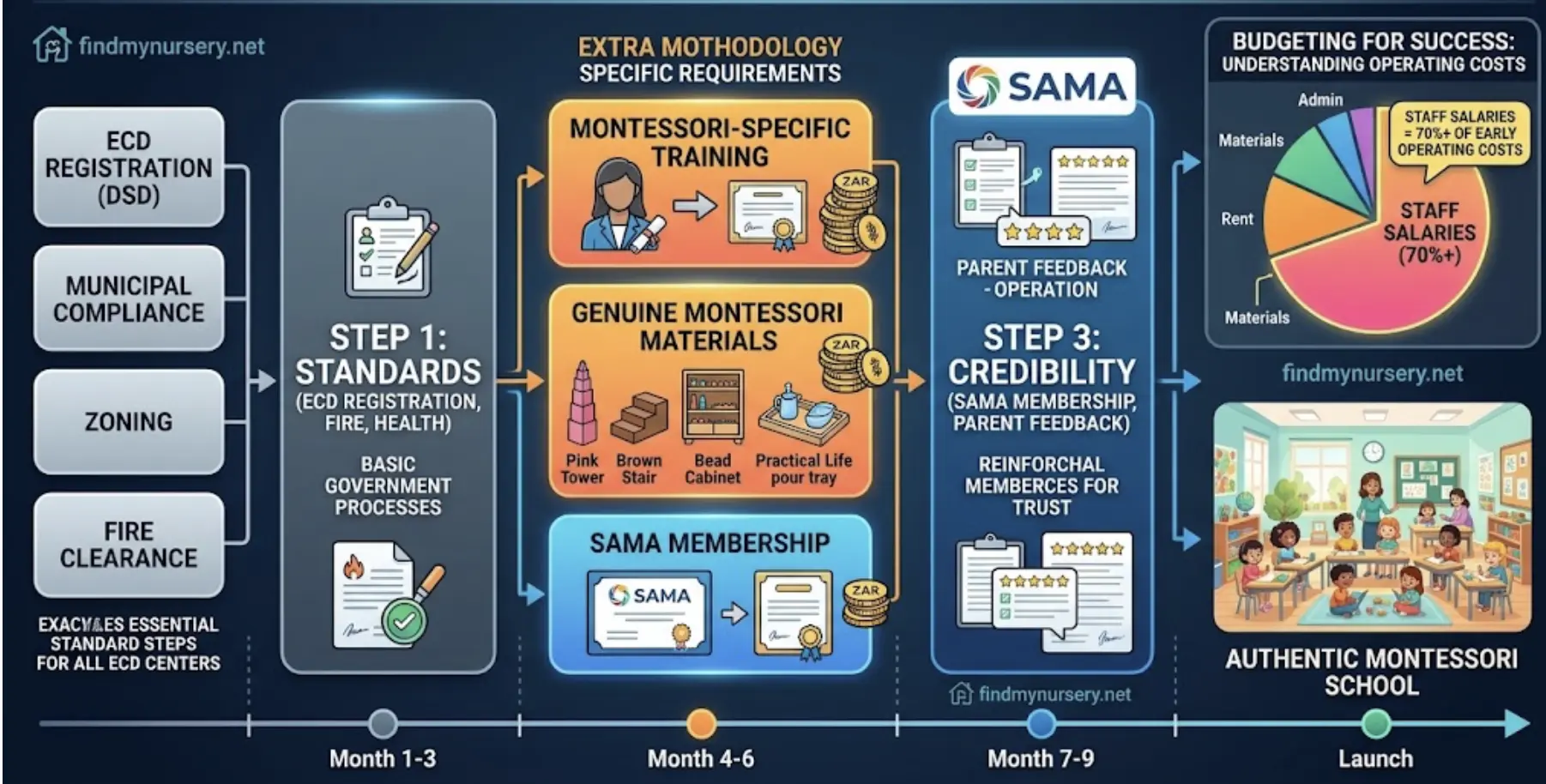
"Montessori" isn't a separate registration category with the Department of Social Development. There's no such thing as a "Montessori licence." A Montessori 3-6 environment is, legally, an ECD centre — so every requirement in our full guide to starting a crèche in South Africa applies to you first: DSD registration, municipal health clearance, zoning and fire compliance, and staff holding the minimum NQF Level 4 ECD qualification required to work as an ECD practitioner. Read that guide before this one, this page only covers what changes once Montessori is your model.
If you plan to offer Grade R and beyond, you also need to register as an independent school with your Provincial Education Department and have every teacher registered with SACE, it's illegal to employ an unregistered teacher, and Umalusi will not accredit a school with unregistered staff. One correction worth being precise about: Umalusi accreditation itself only becomes compulsory once a school offers a curriculum leading to a qualification on the GFETQSF, in practice, once you're carrying learners through to the National Senior Certificate. A Grade R class on its own doesn't trigger it. If you're opening a Montessori primary or high school down the line, budget time for the Umalusi accreditation process; if you're staying at ECD/Grade R level, provincial registration and SACE are your compliance floor.
What actually makes it Montessori
This is the part most new owners skip, and it's the part that gets a school called out by parents later. Two schools can both put "Montessori" on the sign. One runs an authentic, trained, fully-resourced Montessori environment. The other runs a mainstream day care with a few wooden puzzles and a peace corner. Both are legal. Only one is honest.
The South African Montessori Association (SAMA) puts it plainly in their own school-setup guidance: before you do anything else, decide whether you're building "an authentic Montessori School" or "a quality day care with Montessori aspects," and be upfront with parents about which one it is. Parents searching "Montessori school near me" are actively looking for the real thing, our guide to choosing an authentic Montessori school walks through exactly what they're trained to check for: accreditation, staff qualifications, real materials, mixed-age classrooms. Worth reading it from their side, because it's the checklist your own school will be measured against.
If you're going the authentic route, here's what's different from a standard ECD setup.
1. Staff need Montessori-specific training, not just an ECD qualification
Your NQF Level 4 ECD qualification satisfies DSD. It does not make someone a Montessori-trained directress. That's a separate, additional qualification through an accredited Montessori training centre, SAMA lists several in South Africa, including the Montessori Early Learning Foundation (MELF), Headstart, Indaba Institute, and The College of Modern Montessori, offering diplomas at different age bands (0-3, 3-6, 6-12). Budget for this as a real line item: it's additional time and cost on top of standard ECD staffing, and it's the single biggest driver of whether your classroom is genuinely Montessori or Montessori-flavoured.
2. Real materials, not a Montessori-style toy box
A genuine Montessori classroom is built around five structured material areas: Practical Life, Sensorial, Mathematics, Language, and Cultural. These are specific, graded, self-correcting materials designed to be worked through in sequence, not generic wooden educational toys. SAMA's guidance is direct here too: buy from a reputable supplier, many of whom are SAMA associate members, and have a real plan for growing your material sets over time rather than a one-time starter kit. This is a genuine capital cost to plan for before you open, separate from your basic classroom setup budget.
3. The classroom structure works differently, ratios still apply
Montessori environments are typically mixed-age (3-6 in one room, not split by single-year groups) with long, uninterrupted work cycles rather than a timetable of short activities. That changes your room layout and daily schedule. It doesn't change your legal minimum staffing ratios: South Africa's ECD Programme Norms and Standards under the Children's Act set specific caregiver-to-child ratios by age (roughly 1:6 for infants, 1:12 for toddlers, up to 1:30 by kindergarten age), see our full breakdown of ECD staff-to-child ratios, and those apply to your centre regardless of teaching philosophy. What Montessori changes is how you structure a mixed-age room within those ratios, not whether the ratios apply.
4. SAMA membership helps, but it isn't accreditation
Membership isn't a legal requirement to call your centre Montessori, and it isn't the same as accreditation or DSD registration. What it does is connect your school to SAMA's training, supplier and community network, and signal to parents that you're engaged with the wider Montessori movement rather than borrowing the name. It's one of the first things our parent-facing guide tells parents to check for, so it's worth having, but it's a credibility signal, not a legal box to tick.
Choosing premises for a Montessori school

Finding the right building is often the biggest practical obstacle to opening, Montessori or not, but a few things matter more when the model is Montessori. Beyond the standard fire, health and zoning checks, look for enough uninterrupted indoor floor space to lay out five distinct material areas without a cramped, over-stacked room, natural light, direct or easy access to an outdoor area (practical life and sensorial work regularly moves outside), separate ablutions sized for the age group, a kitchen or food-prep area if you're offering meals, and secure, controlled entrances. Before you sign a lease or offer, confirm with your municipality that the specific property is zoned to legally operate as an ECD centre or school, this is one of the most common reasons a launch gets delayed, and it needs to be settled before you spend on renovations or materials.
What does it cost to open a Montessori school?
There's no single national figure, because premises costs alone vary hugely between provinces and even suburbs. But the cost categories are consistent, and Montessori adds two of its own on top of a standard ECD budget:
| Cost area | What it covers |
|---|---|
| Premises | Rent or deposit, renovations, zoning compliance |
| Compliance | Fire, municipal health, DSD/education registration fees |
| Montessori training | Accredited staff diplomas, on top of NQF4 ECD qualifications |
| Montessori materials | The five material areas, plus ongoing replacement/growth |
| Furniture | Child-sized shelving, tables, chairs, storage |
| Outdoor area | Playground equipment, safety surfacing |
| Staffing | Salaries, likely running before enrolment covers them |
| Insurance | Public liability, property, accident cover for learners and staff |
| Marketing | Website, signage, listing and advertising |
| Working capital | Several months to a year of operating costs before break-even |
SAMA's own school-setup guidance is blunt about that last line: budget to operate for up to a year before turning a profit, with teacher salaries alone typically running around 70% of operating costs once you're open. Underestimating working capital, not the opening costs themselves, is what SAMA flags as the thing that catches new schools out.
The rest is the same as any ECD business
Legal structure, business plan, five-year financials, insurance, SARS and UIF registration, employment contracts, none of that changes because you're running Montessori. Our How to Start a Crèche in South Africa guide covers all of it in full. Come back here for the Montessori-specific decisions once the basics are sorted.
Frequently asked questions
Do I need a special Montessori licence in South Africa?
No. There's no separate government licence for Montessori. You register as a standard ECD centre with DSD (and as an independent school with your Provincial Education Department if you go beyond Grade R). "Montessori" is a teaching philosophy, not a registration category.
Do Montessori teachers need a Montessori-specific qualification?
Legally, staff need the minimum NQF Level 4 ECD qualification to work in a registered centre. To run an authentic Montessori classroom, staff additionally need training through an accredited Montessori training centre, that's a separate qualification most new owners have to budget and plan for on top of standard ECD staffing.
Does a Montessori school have to be registered with DSD?
Yes, if it operates as an ECD centre (birth to school-going age), which most Montessori environments in South Africa do. Registration is with the Provincial Department of Social Development, exactly as for any other ECD centre.
How much does it cost to open a Montessori school in South Africa?
There's no fixed national figure since premises and renovation costs vary by location, but budget across ten areas: premises, compliance, Montessori-specific staff training, Montessori materials, furniture, outdoor equipment, staffing, insurance, marketing, and enough working capital to cover roughly a year of operating costs before the school reaches break-even.
Can I call my ECD centre Montessori if my staff aren't Montessori trained?
There's no law stopping you from using the word. Whether that's honest is a different question, and SAMA's own guidance to school founders is to be upfront with parents about whether you're running an authentic Montessori programme or a day care with Montessori-style elements, rather than letting the name imply more than the classroom delivers.
Does SAMA membership make a Montessori school accredited?
No. SAMA membership is a connection to the training, supplier and community network, not a legal accreditation or a substitute for DSD registration.
What age groups can a Montessori school cater for?
Montessori environments typically run from infant/toddler (18 months to 3 years) through 3-6, 6-9, 9-12, and beyond into adolescent programmes, each requiring different training, materials and, past Grade R, different registration and accreditation steps.
What are the legal staff-to-child ratios for a Montessori ECD centre?
The same ones that apply to any registered South African ECD centre, Montessori doesn't have its own legislated ratio. See our ECD staff-to-child ratios guide for the full breakdown by age group.
Quick summary
- Montessori isn't a separate government registration. You register as a standard ECD centre with DSD; Grade R and beyond adds Provincial Education Department registration and SACE-registered teachers.
- Umalusi accreditation only becomes compulsory once a school carries learners toward the National Senior Certificate, it isn't automatic at Grade R.
- NQF Level 4 ECD is the legal staffing minimum. An authentic Montessori programme also needs separate accredited Montessori training (MELF, Headstart, Indaba Institute, The College of Modern Montessori, among others).
- Real Montessori materials span five areas, Practical Life, Sensorial, Mathematics, Language, Cultural, and are an ongoing cost, not a one-time purchase.
- Legal child-to-caregiver ratios under the Children's Act still apply (roughly 1:6 for infants up to 1:30 by kindergarten age) regardless of Montessori's mixed-age classroom structure.
- SAMA membership is a credibility and network signal, not accreditation or DSD registration.
- Premises need space for five material areas, natural light, outdoor access, and confirmed zoning before you sign anything.
- Budget across ten cost categories, and plan for up to a year of working capital before the school breaks even.
Planning to open a Montessori school?
Once you're ready to start attracting parents, list your Montessori school on Find My Nursery so families searching for Montessori ECD options in your area can discover your centre from day one.
List Your School →Already operating?
Claim Your Listing →Sources: South African Montessori Association — school setup guidance · SAMA accredited training · Children's House — How to Start a Montessori School · Umalusi — FAQ for Independent Schools · SACE registration requirements · ECD qualification requirements, Skills Academy · ECD Programme Norms and Standards / registration guidelines
Owners Also Read
How to start a creche in South Africa 2026 Guide
How to Start a Creche in South Africa: Requirements, Costs and Registration What opening...
How Find My Nursery Handles Your Privacy
How Find My Nursery Handles Your Privacy (POPIA Update) How Find My Nursery Handles...
ECD Norms and Standards: Health and Safety Requirements Checklist
ECD Norms and Standards: Health and Safety Requirements Checklist Everything an inspector measures your...
Registered and Ready to Grow?
Get your new centre listed free on Find My Nursery so parents can find you from day one. +240% average visibility boost.
Claim Your School for Free