
How to Register an ECD Centre in South Africa (2026 Step-by-Step Guide)
Everything the DBE's eCares system involves, from your Bronze certificate to full complianceSo you've decided to open a creche, or maybe you've been running one quietly for a while and know it's time to make things official. Either way, you're probably searching for exactly how to register an ECD centre in South Africa, and whether the process you've heard about is even still current. It isn't, not entirely. Here's how registration actually works in 2026, step by step.
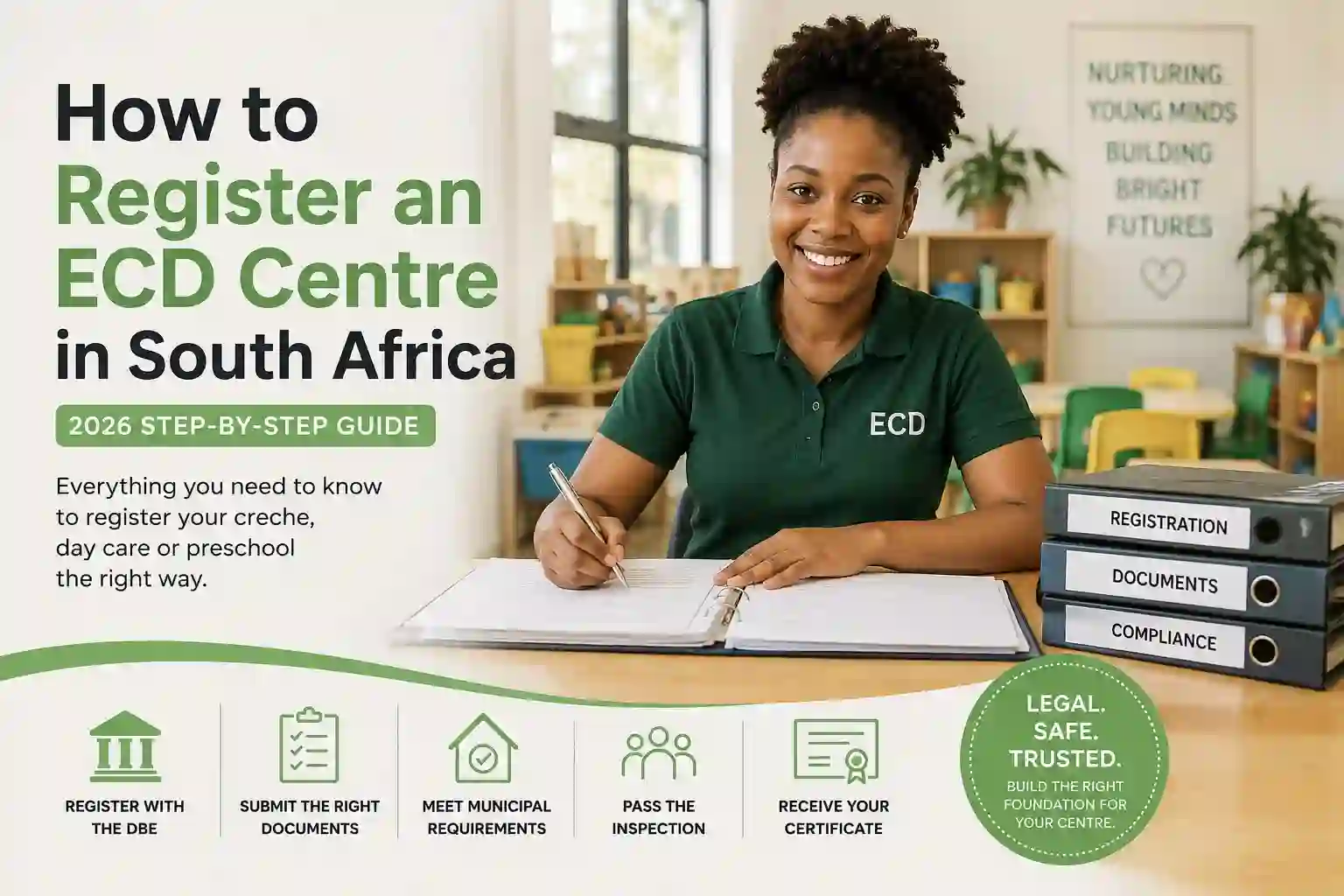
Who Needs to Register an ECD Centre?
Under the Children's Act, if you care for more than six children who haven't started school yet, outside their own home, in exchange for payment, you're running a facility that must be registered. That covers creches, day cares, playgroups and most preschools. It doesn't matter if you're a one-room home-based operation or a purpose-built centre with six classrooms, the same rule applies.
There's one distinction worth knowing early, because it trips a lot of owners up. Full-day ECD centres and programmes, the kind most readers of this guide are running, register with the Department of Basic Education (DBE). After-school care facilities are still registered separately through the Department of Social Development (DSD), the department that historically ran ECD registration before 2022. If you're only offering after-school care, you'll be dealing with DSD and the older Form 11 process rather than DBE's system. Everything else in this guide assumes you're registering a full ECD centre or programme.
More Than Six Children
Caring for 6+ pre-school children, outside their own home, for payment means you must register.
Full-Day ECD
Creches, day cares and preschools register with the DBE through eCares.
After-School Care
Register separately with the DSD using the older Form 11 process.
Step 1: Start With the DBE, Not Your Municipality
Registration moved from DSD to the DBE in April 2022, and since then the DBE has rolled out a proper national system for it, called the Bana Pele Mass Registration Drive. The rollout started in Gauteng, the Free State and the Western Cape, and by 2026 it covers the country, so wherever you're based, this is the process you'll be going through.
Your first practical step is to reach the DBE's registration channel directly. You can apply through the eCares registration portal, or message the eCares WhatsApp bot on 087 725 2059 to get guided through what's needed from your phone. If your centre is already known to the DBE's database, you may even be contacted directly through this number once the rollout reaches you, so save it regardless of which way you start.
Registration is entirely free, and the DBE has publicly warned owners not to pay anyone who claims to charge for registration support.
The Forms You Actually Need for eCares
This is where most owners get confused, because the forms you'll hear mentioned depend entirely on which route you're on. If you're registering a full ECD centre through eCares, you don't need Form 11 — that belongs to a different, older process. What you actually need for your Bronze certificate is:
- Certified ID or passport copies: For yourself and every staff member.
- A completed Form 30 for each person: This is the National Child Protection Register clearance form. Form 29 isn't required for eCares, even though older pages may mention it.
- Basic staff and child information: Including qualifications and age groups.
Once you've got your Bronze certificate, moving on to Silver and Gold means gathering a few more documents: a simple business plan explaining how your programme runs, a hand-drawn overhead layout of your site, founding documents if you're an NPO, trust or company, and an emergency plan with evacuation routes and emergency numbers, displayed where staff can see it.
Form 11, if you've heard of it, is the actual application form for registering as a partial care facility with the DSD — that route is for after-school care centres, not full-day ECD centres. If you're not sure which one applies to you, resolve that uncertainty with your provincial DBE office before you submit anything, since sending the wrong form to the wrong department is one of the most common reasons registrations stall.
Step 2: Sort Out Premises, Zoning and Health Clearance
DBE registration covers your programme. Your municipality still needs to sign off on the building itself. You'll need to confirm the right of use for your premises with your local municipality, meaning the property is legally allowed to operate as an ECD centre, and you'll need a health clearance certificate confirming the space is safe and suitable for young children.
This part hasn't changed with the move to DBE, and it's easy to underestimate. Zoning rules differ by municipality, so a home that works for a small home-based creche in one area might need a formal zoning application in another. Sort this out early, ideally before you commit to a lease or a mortgage, because a beautiful building that fails zoning is an expensive mistake.
Step 3: The Inspection, and How to Be Ready
Once your application moves past Bronze, expect site visits from your local Education District office and an Environmental Health Practitioner. They're checking your premises against the national norms and standards for ECD centres. Three things are worth sorting out before anyone arrives:
- Walk your space like an inspector would: Check fencing is secure, your fire extinguisher is serviced and in date, and hazards like exposed sockets or unlocked cleaning chemicals are dealt with. Most delays come from small things owners stopped noticing.
- Have paperwork physically ready, not just uploaded: Your emergency plan should be visibly displayed, and your first aid kit and evacuation route should be obvious to anyone walking in.
- Know your numbers: Staff-to-child ratios, children enrolled per age group, and your food preparation setup should all match exactly what you declared online. Inspectors check for consistency.
Step 4: Bronze, Silver and Gold Explained
Registering an ECD centre in South Africa isn't a single certificate anymore, it's a staged process. Here's how the three tiers compare:
| Tier | What It Means | Validity |
|---|---|---|
| Bronze | Your starting point. Requires ID copies and Form 30 clearances for all staff. | Valid for 12 months |
| Silver | Adds business plan, site layout, founding documents and emergency plan. | Around 3 years (varies by province) |
| Gold | Full compliance with national norms and standards. | Longest-term registration |
There isn't one fixed timeline the DBE promises for moving through Silver and Gold, since it depends on your province's rollout stage and how quickly your documentation and site visit come together. If you're going through the older DSD partial care route instead, government guidance states that process can take up to three months to issue a certificate. Either way, start earlier than you think you need to — owners who leave this until they're already enrolling children tend to have the roughest time.
What Registration Actually Costs
Registering with the DBE itself costs nothing. But getting compliant enough to pass registration is a different story, and this is the part that catches owners off guard. A recent report on the ECD sector's compliance burden found that for private centres working through full compliance — from zoning approval and building plan sign-off to fire compliance and health certifications — costs can run into the tens of thousands of rand, and in some cases considerably more, before a single child is enrolled.
Not every centre will face costs at that scale, and how much you'll spend depends heavily on your starting point and your municipality. As one example, some Western Cape service providers charge a small fee, around R300, just for a copy of an approved building plan if you don't already have one on file. Fencing repairs, fire extinguisher servicing, and minor building work to meet space or toilet ratio requirements are the kinds of line items that add up fastest. Budget for compliance as a real, separate cost from the registration process itself.
Common Reasons Applications Get Delayed
Most delays come down to the same handful of issues:
- Missing Child Protection Register clearance: Even one uncovered staff member holds up the whole file. Don't submit until every adult on your premises is cleared, including part-time and casual staff.
- Vague business plans: Incomplete plans are a common snag, along with site layouts that don't match what inspectors find on the ground.
- Zoning and right-of-use problems: The hardest to fix quickly, since they involve your municipality rather than the DBE. Resolve any doubt before you lodge anything else.
- Wrong department: If you're applying through the after-school DSD route, make sure you're completing Form 11 rather than trying to register through eCares.
After You're Registered: Staying Compliant and Getting Found
Once you've got your certificate, the compliance side doesn't stop. Your programme stays subject to ongoing monitoring, and if your staff, premises or documentation change, you need to keep the DBE updated. Treat registration as a living requirement, not a box you tick once and forget.
The part most owners don't expect is what comes right after: actually being found by parents. Being legal doesn't automatically mean being visible.
Registered? Now Let Parents Find You
We built Find My Nursery around exactly this gap. Once you're registered, claim your free profile so parents searching in your area can actually find you.
Claim Your Free ProfileQuick Answers to Common Questions
How do I register an ECD centre in South Africa? Apply through the DBE's eCares portal or its WhatsApp bot, submit Form 30 clearances and ID documents for Bronze, then work through business plan, site layout and emergency plan documents for Silver and Gold.
Is ECD registration free? Yes. The DBE doesn't charge for registration itself. The costs come from meeting compliance requirements on your premises, not from the application.
What's the difference between Form 11 and eCares registration? Form 11 is for registering a partial care facility with the DSD, mainly used for after-school care. Full-day ECD centres register through the DBE's eCares system instead.
How long does ECD registration take in 2026? There's no single fixed timeline for Silver and Gold under eCares, since it depends on your province's rollout progress. The older DSD partial care route can take up to three months for a certificate.
Department of Basic Education Department of Social Development SA Western Cape Government: ECD Services South African Government: Register an ECD Centre
Owners Also Read

How to Open a Montessori School in South Africa
How to Open a Montessori School in South Africa | Find My Nursery How...

ECD Norms and Standards: Health and Safety Requirements Checklist
ECD Norms and Standards: Health and Safety Requirements Checklist Everything an inspector measures your...
How to start a creche in South Africa 2026 Guide
How to Start a Creche in South Africa: Requirements, Costs and Registration What opening...
Registered and Ready to Grow?
Get your new centre listed free on Find My Nursery so parents can find you from day one. +240% average visibility boost.
Claim Your School for Free