
Beyond the Directory: How to Use Find My Nursery's Data to Make Smarter Decisions
Claiming your profile gets you found. Completing it gets you trusted. But there's a third layer most schools never get to, and it's the one that turns a directory listing into an actual decision-making tool: the data.
Every claimed profile on Find My Nursery sits inside a platform that's watching, in aggregate, exactly how parents in South Africa search for childcare. That's not a vanity number. It's information you can act on. Here's how.
Don't just look at your view count, look at where it's coming from
Your dashboard shows profile views, WhatsApp clicks, calls and enquiries over time. Most owners check the total and move on. The more useful habit is checking the trend and the source together. A spike in views with no matching rise in enquiries usually means your profile is being found but isn't converting, which points back to photos, description or response time, not to visibility.
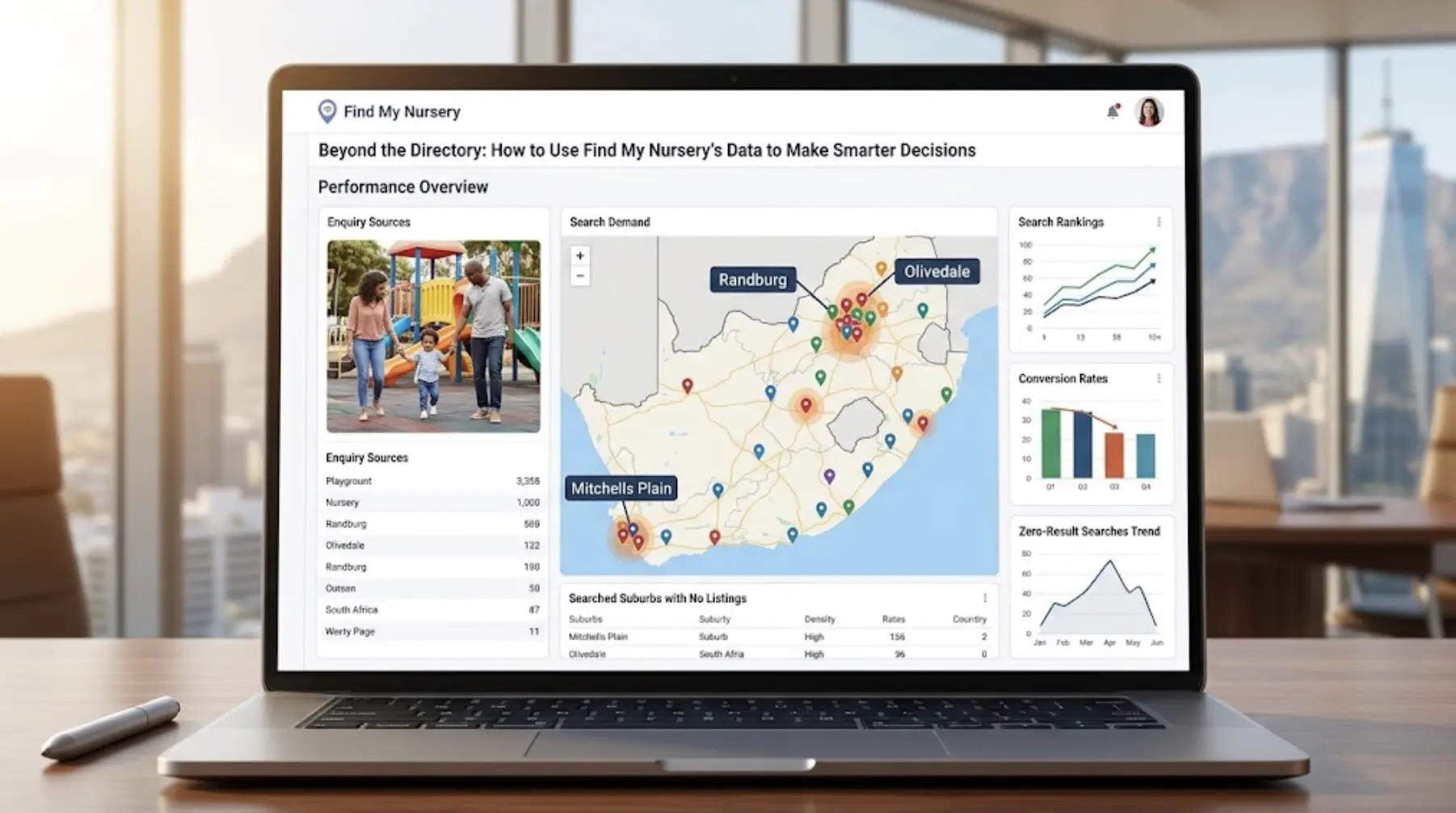
Platform-wide, this pattern is visible at scale. Over the past month, schools on Find My Nursery grew close to 49% while enquiries grew 55%, but overall conversion rate actually dipped slightly. The lesson generalises to your own profile: growth in traffic doesn't automatically mean growth in enrolments. It's what happens on the profile itself, photos, WhatsApp, response speed, that decides whether a view becomes a family walking through your door.
Look at where the demand actually is, not where you assume it is
We track search demand by suburb across the whole platform. Right now, areas like Randburg and Mitchells Plain are seeing some of the highest search impressions on the platform, and neighbourhoods like Olivedale in Randburg are showing very high views relative to the number of schools listed there, a sign that demand is currently outpacing supply in that specific pocket.
If you're a school considering a second site, a satellite branch, or even just deciding which suburb to run a local ad in, this is exactly the kind of signal that should inform the decision, not a guess based on where you happen to already know people.
See your own numbers
Search Performance, profile views, WhatsApp clicks and more are all in your dashboard.
Go to Your DashboardZero-result searches show you where parents are looking and finding nothing
One of the more useful, and less obvious, things our data tracks is searches that return no results at all. Parents are actively typing suburb names into Find My Nursery where we don't yet have enough listed schools to show them anything. That's unmet demand, sitting there in plain sight.
For an established school thinking about expansion, or a school in an area just outside our current coverage, that's a genuine market signal worth more than most paid research. It tells you parents in that specific area are already looking for exactly what you offer.
Reviews aren't just trust signals, they're product feedback
It's easy to treat reviews purely as marketing. But read them as data and they tell you what parents actually value about your school, staff warmth, communication, a specific programme, cleanliness, and what keeps coming up as a gap. Schools that reply to reviews and act visibly on the feedback in them tend to keep collecting more, which keeps the signal fresh.
Use your Quarterly Growth Report as a check-in, not just a PDF
Premium schools receive a Quarterly Growth Report with a consultation. Treat that meeting as a genuine check-in against your own goals for the term or the year, not a formality. Bring your own questions: which search terms are actually sending you enquiries, how your profile completeness compares to schools ranking above you locally, and whether your enquiry-to-enrolment conversion has moved since your last review push.
The bigger point
A directory listing is passive. Data is active. The schools getting the most out of Find My Nursery aren't the ones with the flashiest profiles, they're the ones treating their dashboard the way they'd treat their enrolment register: checked regularly, acted on, and used to make the next decision, not just admired after the fact.
If you haven't claimed your school yet, none of this is available to you. Start with the basics: Why You Should Claim Your Nursery School Profile, then You've Claimed Your Profile, Now What?
See your own data: findmynursery.net/grow-your-nursery
Not claimed yet? findmynursery.net/claim-your-school
Source: Find My Nursery internal platform analytics, period ending 27 August 2026. Suburb and search figures reflect a rolling 28-day window and change over time.
FAQs
Where do I actually see this data for my own school?
Your dashboard's Search Performance section (Overview, Google Rankings, Site Search) shows your own profile's views, clicks and ranking trends. Platform-wide figures like area demand are shared through our data guides and updates, not inside an individual dashboard.
Why would my views go up but my enquiries stay flat?
It usually points back to the profile itself, incomplete photos, no listed fees, a WhatsApp number that isn't monitored, rather than a lack of interest. A rise in traffic without a rise in enquiries is a signal to revisit your profile, not your marketing.
What is the Quarterly Growth Report, and who gets it?
It's a Premium feature, a quarterly report plus a consultation covering your school's performance and where to focus next. Use it as a working check-in, not just a document to file away.
Is area-level search demand data available if my school isn't in that suburb yet?
The insight is still useful. Zero-result searches and high-demand, low-supply suburbs are exactly the kind of signal worth factoring into decisions about a new site or a local ad push, even before you have a listing there.
How often does this data update?
Platform metrics and search demand are tracked on a rolling basis (typically a 28-day window for area and search figures), so they shift over time. Treat any single snapshot as a trend indicator, not a permanent ranking.
Quick Summary
- A directory listing is passive. The data behind it is active, and most schools never use it.
- Check the trend, not just the total: views up with enquiries flat usually means a profile problem, not a demand problem.
- Search demand by suburb (currently strongest in areas like Randburg and Mitchells Plain) shows where parent demand is outpacing school supply, useful for expansion or ad-spend decisions.
- Zero-result searches, parents searching suburbs with no results, are a real, visible signal of unmet demand.
- Reviews double as product feedback: read them for what parents actually value, not just as a trust badge.
- Premium schools should treat their Quarterly Growth Report as a working check-in, not a formality.
- This only works once you've claimed and completed your profile.
Owners Also Read
Owners Also Read
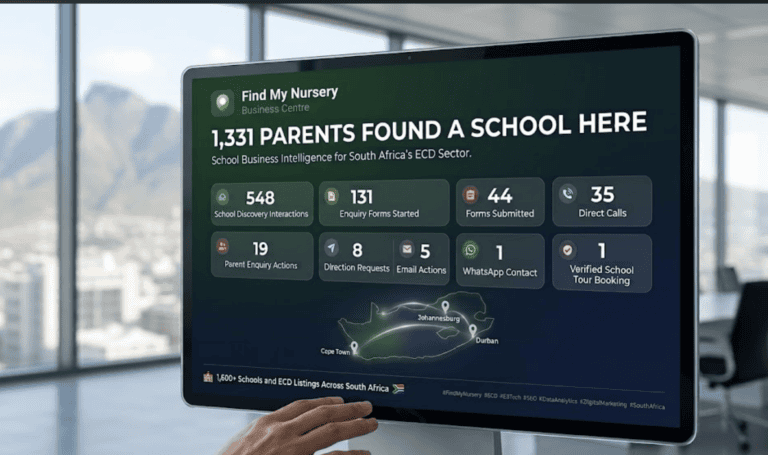
Introducing the Business Centre: The Evolution of ECD School Analytics
Inside the Find My Nursery Business Centre: The Intelligence Layer Behind the Platform What...

The Largest Nursery School Directories in South Africa (2026 Independent Research)
The Largest Nursery School Directories in South Africa (2026 Independent Research) | Find My...

How Do South African Parents Choose a Preschool? What Our Data Shows
How Do South African Parents Choose a Preschool? What Our Data Shows What parents...
This Is Your Market. Be Visible In It.
Parents searched Find My Nursery thousands of times last month. If your school is not claimed and complete, they are finding someone else.
Claim Your School for Free